Our projects tell the stories of how we deliver a lasting impact for our clients.Explore some of our favorites

A secure facility can be designed to meet the right requirements on paper and still encounter problems during construction. Existing building conditions, limited space, and seemingly minor field changes create conflicts that become increasingly difficult to correct as construction progresses.
For owners, understanding where those challenges commonly occur helps identify potential risks before they lead to issues during final accreditation.
Here, we outline five building system challenges to watch for during secure facility construction:
Secure perimeter walls extend from slab to slab, limiting the ways air can move out of the space and return to the mechanical system. That makes properly planned return air pathways especially important.
If field conditions or coordination changes restrict those pathways, the impact extends beyond comfort. Improper pressurization makes doors difficult to open or prevents them from closing properly, creating another vulnerability in the secure perimeter.
Supply air creates a different challenge at the secure perimeter. Where ductwork penetrates the boundary, required waveguides restrict airflow. As a result, the ductwork needs to increase in size as it passes through the secure wall to maintain the necessary air distribution within the space.
That becomes particularly challenging when the existing building distribution has already established how much space is available. A condition that works in the base building may not translate directly into the secure facility without careful coordination.
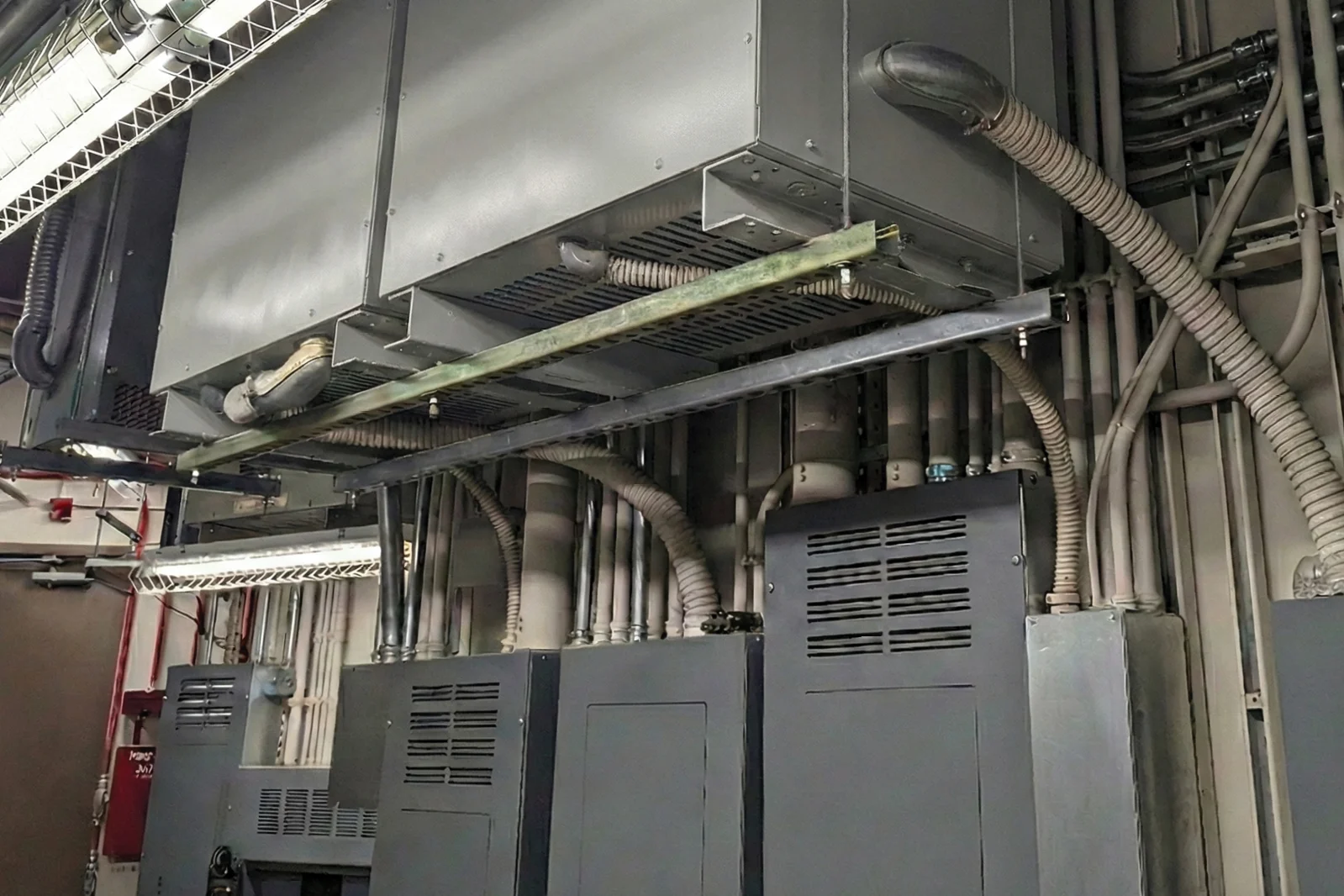
Secure facilities require multiple networks as well as red and black power distribution, all competing for limited space above the ceiling while maintaining required separations.
This is where coordination between trades becomes critical. Mechanical systems, electrical distribution, and specialty piping may already occupy the available space by the time low-voltage infrastructure is installed. If the necessary pathways have not been maintained, entire electrical feeds or fiber distribution may need to be rerouted.
Those changes snowball. Rerouting infrastructure affects ceiling heights, door openings, and other previously coordinated elements of the design.
Doors are a critical part of the secure perimeter, and successful installation starts before the doors arrive on site.
Floor levelness, framing, and door openings affect whether the required Radio Frequency (RF) and Sound Transmission Coefficient (STC) seals are achieved. If those conditions are not properly maintained throughout construction, installers are forced to adjust once the doors and frames arrive, and discrepancies make it difficult for the doors to seal and operate as intended.
Existing fire protection systems create additional challenges because a secure facility needs to limit the number of penetrations through its perimeter. A base building sprinkler system designed to serve an entire floor may have multiple branches that would otherwise cross the secure boundary, potentially requiring modifications to the existing system. If those modifications were not anticipated, they can have significant budget implications.
Fire alarm systems introduce another point of coordination. The secure facility’s system must work with the base building system while accounting for required RF filtering. Some existing systems accommodate those requirements more easily than others; in other cases, additional equipment is necessary, adding cost and complexity.
A change to one system affects the space available for another, creating a ripple effect across the project. And the later a conflict is discovered, the more significant the potential impact on cost and schedule, and, of course, on the final accreditation.
That’s why successful secure facility projects require more than a compliant design. They require coordination between the design and construction teams and an understanding of how decisions in the field affect the secure facility as a whole.
Are you asking the right questions to the right people? Our team can help identify and navigate building system challenges before they put accreditation at risk – connect with me now at gbrenner@wbengineering.com.